Packaging & Sharing Experiments
Chameleon Trovi is a sharing portal that allows you to share digital research and education artifacts, such as images, complex appliances, packaged experiments, workshop tutorials, or class materials. Each research artifact is represented as a deposition (a remotely accessible folder) where a user can put Jupyter notebooks, links to images, orchestration templates, data, software, and other digital representations that together represent a focused contribution that can be run on Chameleon. Users can use these artifacts to recreate and rerun experiments or class exercises on a Jupyter Notebook within Chameleon. They can also create their own artifacts and publish them directly to Trovi from within Chameleon’s Jupyter server.
Note
Trovi is now the sole home for Chameleon appliances as well as user experiments. All Chameleon-supported OS images and Complex Appliance heat templates are published and discovered on Trovi by filtering for the appliance tag — the legacy Appliance Catalog is deprecated and no longer used.
To get started, find the “Trovi” dropdown option under the “Experiment” section of chameleoncloud.org. Once you’re on the Trovi homepage, you’ll see a list of publicly available experiments and other digital artifacts. You can now browse those artifacts or upload your own.
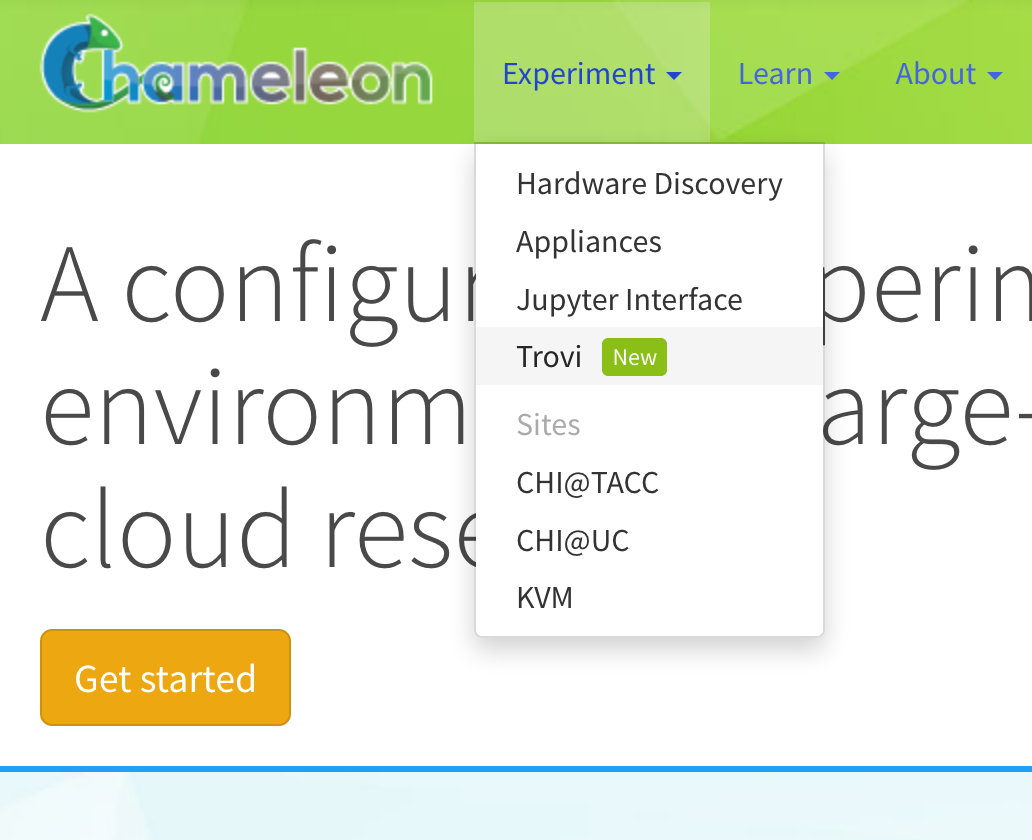
The “Trovi” option under the “Experiment” section takes you to Trovi.
Once your artifact is packaged and shared, you may also want non-Chameleon users to be able to reproduce it — see Daypass: temporary access for reproduction for how to grant reviewers and collaborators temporary access without a full Chameleon allocation.
Packaging & Sharing Topics