Sign In with Federated Identity
Federated login enables users to use a single set of credentials to log into many different services. For example, federated login allows you to use your university or other institutional credentials to log into Chameleon–there is no need to create a new account. In addition, since federated login is supported by many testbeds and services across scientific infrastructures you will be able to sign in once and use multiple services.
Chameleon uses Globus Auth, a popular authentication service, to implement federated login and federates with entities supported by Globus. We strongly recommend using federated login as it’s the simplest and most convenient way to access Chameleon. Users can sign in using their existing institutional account if their institution is an InCommon member, use their Google account, or create a Globus ID tied to an email and password that they provide.
Note
This page covers browser-based login to the Chameleon user portal, the testbed GUI, and the Jupyter environment. The Command Line Interface authenticates separately — signing in here does not by itself give you CLI credentials. See CLI authentication to set up CLI access.
Logging in
To log in to the Chameleon user portal, where you can manage your projects, user profile, and submit Help Desk tickets, use the “Log in” button.
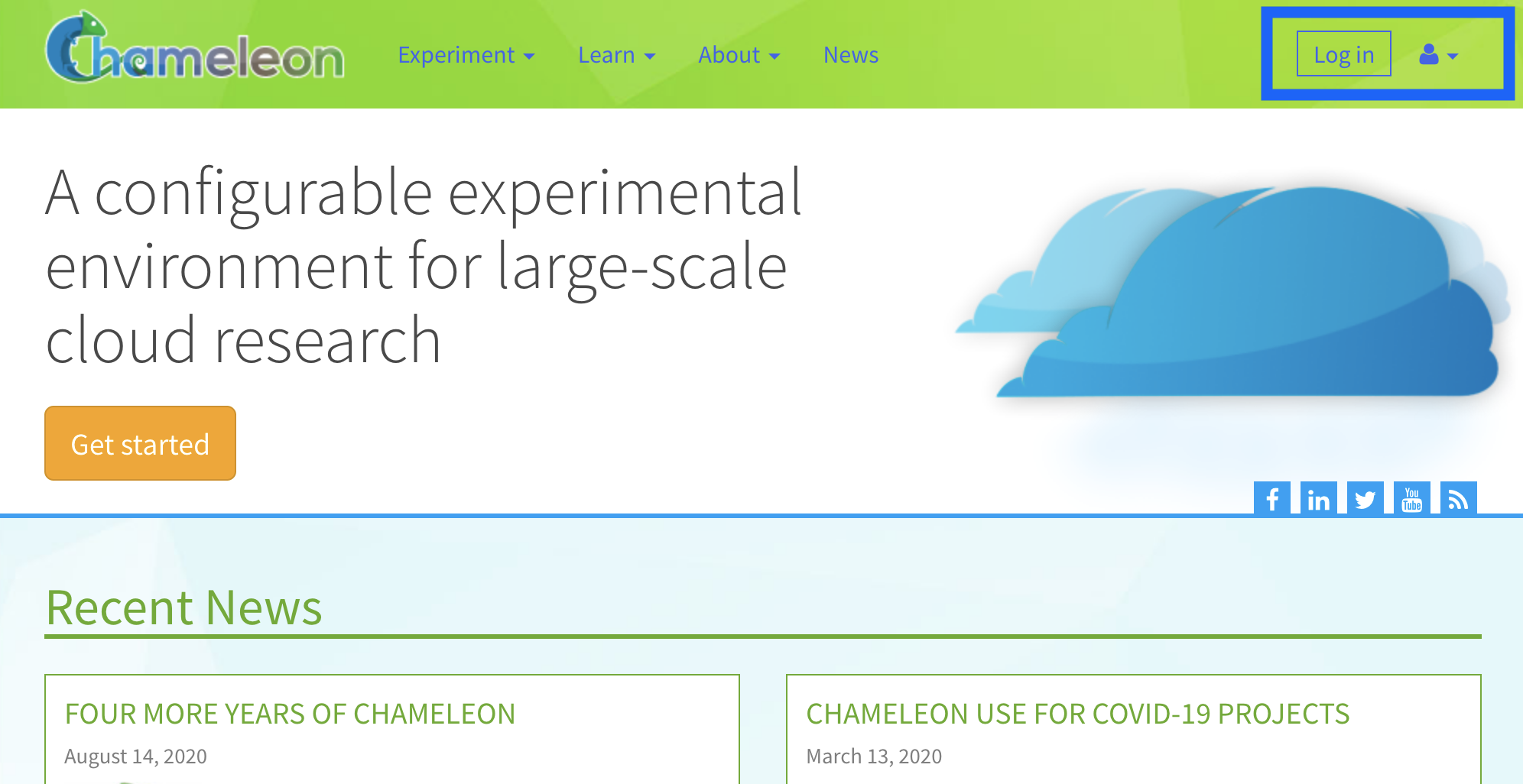
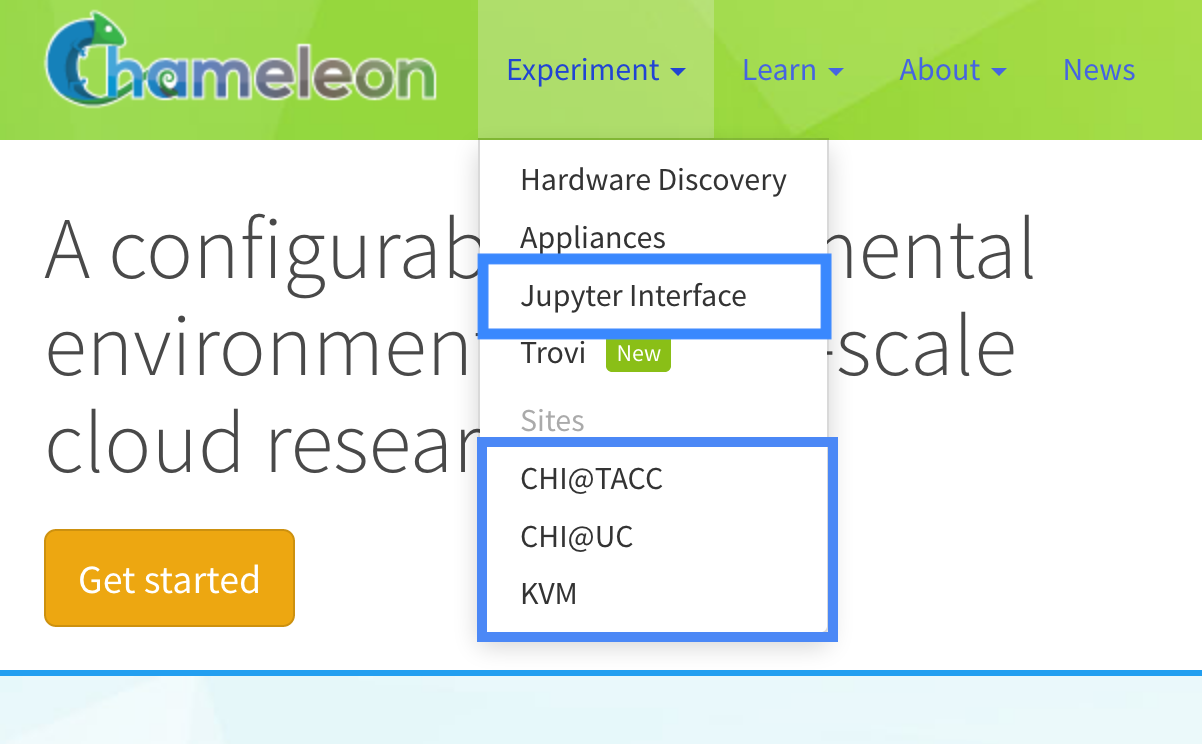
To log in to any of the testbed sites (CHI@TACC, CHI@UC, CHI@NCAR, CHI@Edge, KVM@TACC) or the Jupyter environment, just click their item in the “Experiment” dropdown on chameleoncloud.org. The login process is triggered automatically.
Warning
You must be part of a project with an active allocation to use the CHI sites! Refer to our project management guide for details on creating a project or joining an existing one.
Tip
You can bookmark the URLs to the testbed sites and Jupyter environment if you want to access them directly in the future.
You will be taken to a Single Sign On (SSO) page with several authentication options.
Authentication options
Sign in via federated identity ⭐ RECOMMENDED: This is the simplest way to access Chameleon! Use your existing institution, research lab, or university credentials to log in. This requires your host institution to participate in the InCommon federation. Most major universities and research institutions are already members.
Google: Sign in with any Google account if your institution isn’t part of InCommon or if you prefer using your Google credentials.
ORCiD: Sign in with a valid ORCiD account for research credential integration.
Warning
You may not find your institution on Globus. If so, you can still create an account with another identity, such as Google or ORCiD. However, we encourage users to sign up using their institution, as it helps the Chameleon operators verify user identity, which is an essential step to getting Principal Investigator status on the testbed.
Note
Chameleon has fully migrated to federated identity authentication. Legacy Chameleon username/password accounts are no longer supported.
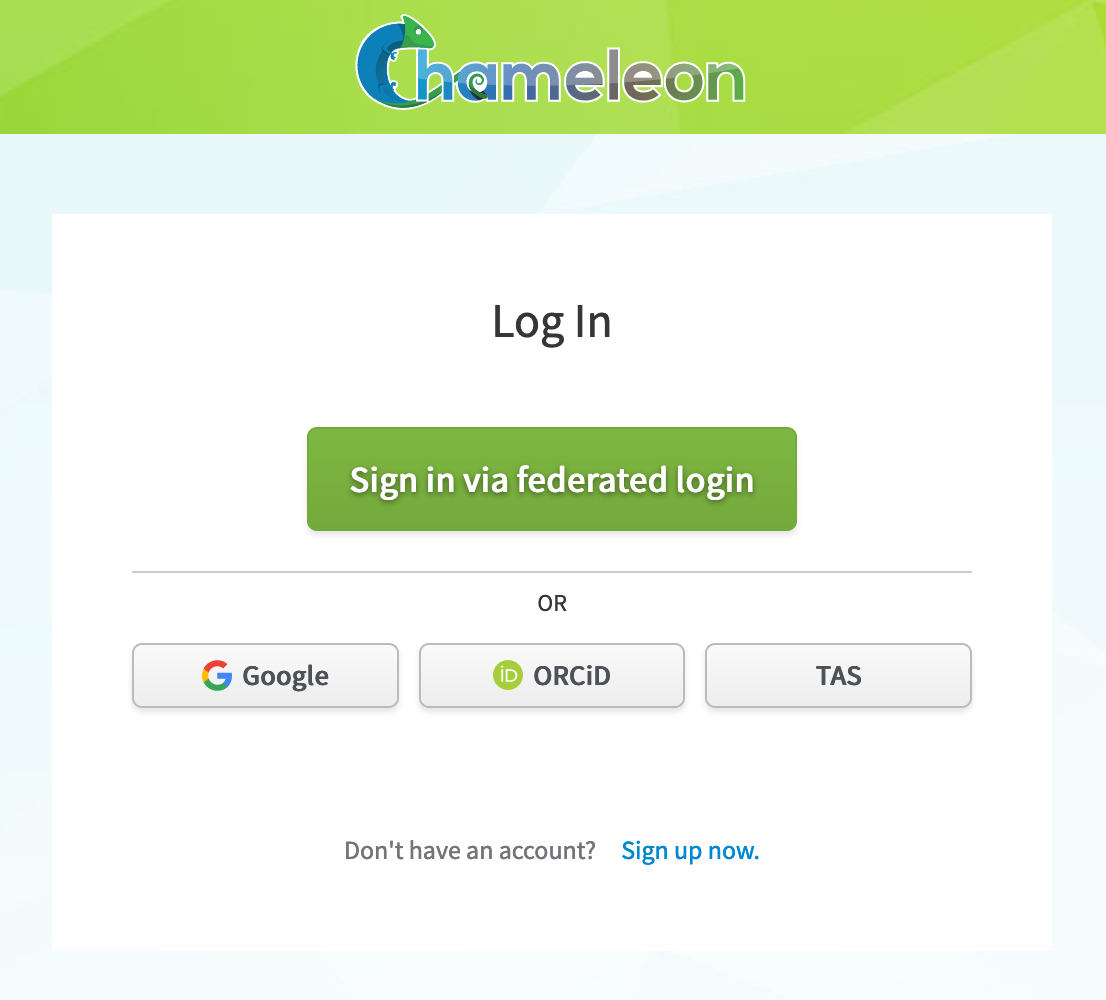
The Single Sign On (SSO) portal login page.
Terms and conditions
When creating an account, you will be asked to review and consent to the Acceptable Use Policy, which governs all use of Chameleon resources and applies to every project on the testbed.
As part of these terms, among others, you are requested to acknowledge Chameleon in publications produced using the testbed. See our FAQ for information on how to cite Chameleon and the suggested acknowledgement text. The FAQ also covers other common policy questions about allocation charges, usage best practices, and more.
Account linking
Chameleon accounts are linked to a federated identity provider, Globus. You’ll need to (re-)link your account if you’re no longer able to log in via your original account source (e.g. you move institutions), or if you’re stuck in an “account already exists” login loop because you have two separate Globus identities (e.g. a Google sign-in and an institutional login) pointing at two different Chameleon accounts. Either way, the fix below assumes you have access to the same email address as your existing account.
Note
Previously Chameleon also supported federated identity via TACC, but this is no longer supported after January 2026. If you previously were using TACC to login to Chameleon, we recommend following the steps below to link your account to Globus.
Log out of the Chameleon site via the menu on the top right of the web page on whatever platform you are using.
Sign into Globus with the same primary email address as your Chameleon account. If your institution is not supported by Globus login, we recommend creating a Globus ID or ORCID account.
Return to the Chameleon website from step 1, and click “Log in” and then “Sign in via federated login”.
If an existing Chameleon account was found with the same email address, you will see a message saying “You need to verify your email address to link your account with Globus Auth.” Check your email inbox for a verification link. Once you click this link, your Chameleon account will now be linked to the Globus account from step 3, and you should use this login method when using Chameleon in the future.
If you don’t see this message, then your Globus account is using an email address that Chameleon doesn’t have registered. Please contact the Help Desk for further assistance regarding this or any other issue with the account linking process.
Lost access to your original email
If you no longer have access to the email address on your existing account — for example, you graduated, changed jobs, or your institution migrated email domains — you won’t be able to complete the verification step above, since there’s no inbox to receive the link.
In this case, contact the Help Desk directly and include:
The old email address on your existing Chameleon account
The new email address you’d like to use going forward
Your institution (old and new, if it changed)
Staff will use this information to verify your identity and relink your account manually.
Troubleshooting login issues
If you experience difficulty logging in, try these solutions:
Common Authentication Issues:
“An account with this email already exists” / repeated login loops: This almost always means you have two separate Globus identities (for example, a Google sign-in and an institutional SSO login) pointing at two different Chameleon accounts. Follow the Account linking steps above to link them into one. If two accounts still won’t merge afterward, contact our Help Desk and ask staff to merge them manually.
Prompted for a username and password: Federated accounts never have a separate Chameleon password to reset — there’s nothing behind that screen. Landing here instead of your institution’s login page is a symptom of the same unlinked-identity issue above, not a forgotten credential; resetting a password will not fix it.
“Account is disabled, contact your administrator”: This means your account was automatically locked out after repeated failed login or authentication attempts (often triggered by scripted or CLI logins using stale credentials) — it is not a ban, and it isn’t something you can resolve yourself. Contact our Help Desk and staff will re-enable it for you.
Institutional credentials not working: Ensure your institutional credentials are up-to-date and correctly linked to your Chameleon account
Browser issues: Clear your browser cache and cookies, then try logging in again
Getting Help:
For persistent login issues, contact our Help Desk with details about:
Which authentication method you’re trying to use
Any error messages you’re seeing
Your institutional affiliation (if using federated login)